
Name:Hanks wu
Position:Engineer
Date: August 16, 2026
How Professional Buyers Can Evaluate Bremelanotide Identity, Analytical Purity, Batch Documentation and Manufacturer-Direct Supply
Research-use notice: The PT-141 material described on this website is supplied exclusively for qualified laboratory research and analytical applications. It is not intended for human consumption, clinical use, diagnosis, treatment, drug compounding or veterinary use.
PT-141 is one of the best-known names in melanocortin receptor research. It is also one of the most frequently misunderstood names in the commercial peptide market.
A search for PT-141 produces clinical-trial publications, information about the prescription product Vyleesi, research-chemical catalogues, online testimonials and unsupported promotional claims. These sources do not always describe equivalent materials.
For professional B2B purchasers, the central question is therefore not whether PT-141 has received positive attention online.
The more important question is:
Does the supplied batch have a clearly defined molecular identity, chemical form, analytical profile and traceable quality record?
What Is PT-141?

PT-141 was the development designation used for bremelanotide, a synthetic cyclic heptapeptide derived from melanocortin peptide research.
Its reported peptide structure is:
Ac-Nle-cyclo-(Asp-His-D-Phe-Arg-Trp-Lys-OH)
Bremelanotide acts as a non-selective melanocortin receptor agonist. Its receptor activity includes MC1R and MC4R, as well as MC3R and MC5R activity. This receptor profile has made the compound relevant to neuropharmacology, receptor-binding, signalling-pathway and analytical peptide research.
Bremelanotide free base and bremelanotide acetate should not be described as though their formulas are automatically identical. The free peptide is commonly represented as C50H68N14O10, while the reported formula of an acetate form depends on the amount of associated acetic acid.
A qualified supplier should therefore identify whether the quoted specification refers to:
- Bremelanotide free base
- Bremelanotide acetate
- A defined acetate stoichiometry
- A calculated peptide-equivalent content
- A lyophilized preparation containing additional components
The released Certificate of Analysis should control over a generic catalogue description.
PT-141 Research Material Is Not Automatically Equivalent to Vyleesi
Vyleesi is an FDA-approved prescription product containing bremelanotide acetate. Its approval applies to a specific sterile formulation, manufacturing process, quality system, container and clinical indication.
The approved indication is limited to premenopausal women with acquired, generalized hypoactive sexual desire disorder whose condition is not explained by a medical or psychiatric condition, relationship problems or another medication.
The approved product is not indicated for men, postmenopausal women or general sexual-performance enhancement.
A third-party vial of lyophilized PT-141 research material is not Vyleesi merely because both use the term bremelanotide.
It should not be presented as:
- An FDA-approved product
- A generic version of Vyleesi
- A clinically interchangeable product
- A treatment for male sexual dysfunction
- A performance-enhancement product
- A sterile medicine unless full pharmaceutical requirements have been met
Clinical evidence involving the approved drug cannot establish the quality, safety or biological equivalence of an independently manufactured research peptide.
Why Is PT-141 Important in Laboratory Research?
PT-141 is scientifically notable because its primary research pathway differs from phosphodiesterase inhibitors that are generally studied in relation to peripheral vascular mechanisms.
Melanocortin receptor research examines central and peripheral signalling systems associated with behavioural, neurological, pigmentation, metabolic and vascular responses.
Potential non-clinical research areas include:
- MC1R, MC3R, MC4R and MC5R receptor-binding studies
- Agonist potency and receptor-selectivity comparisons
- Intracellular signalling assays
- Structure–activity relationship research
- Cyclic peptide synthesis and characterization
- Chromatographic method development
- Mass-spectrometric sequence confirmation
- Peptide stability and degradation studies
- Formulation compatibility research
- Comparative analysis of melanocortin analogues
- Reference-material and analytical-method qualification
The purchasing laboratory must independently determine whether a specific batch is suitable for its assay, instrument and acceptance criteria.
What Does the Clinical Evidence Show?
Two similarly designed Phase 3 trials evaluated prescription bremelanotide in 1,247 premenopausal women with acquired, generalized hypoactive sexual desire disorder.
Compared with placebo, the studies reported statistically significant improvements in the measured sexual-desire domain and reductions in distress associated with low sexual desire.
The results should nevertheless be communicated accurately.
The trials did not demonstrate a statistically significant difference between treatment and placebo in the change in the number of satisfying sexual events, which was a secondary endpoint.
A balanced scientific interpretation is therefore that bremelanotide demonstrated measurable effects on certain validated desire and distress outcomes in the studied population. The evidence does not support describing every outcome as improved, nor does it support extending the findings to unrestricted populations or unverified research materials.
What Do Safety Data Show?

The most frequently reported adverse reaction in the pivotal trials was nausea.
In the pooled Phase 3 data, reported adverse-event rates included:
- Nausea: 40.0%
- Flushing: 20.3%
- Injection-site reactions: 13.2%
- Headache: 11.3%
- Vomiting: 4.8%
- Fatigue: 3.2%
- Dizziness: 2.2%
The prescribing information also warns about transient increases in blood pressure, reductions in heart rate and focal hyperpigmentation. The approved product is contraindicated in patients with uncontrolled hypertension or known cardiovascular disease.
These clinical findings relate to the approved prescription formulation under defined study conditions. They should not be used to create consumer instructions for a research-grade material.
How Should Professional Buyers Interpret Online Reviews?
Online PT-141 reviews are sharply divided.
Some reviewers describe a noticeable increase in desire or response. Others report nausea, flushing, headache, delayed effects, inconsistent responses or no perceived effect.
A review website currently reports an average bremelanotide rating of approximately 7.3 out of 10 across 42 submitted reviews, with more positive than negative submissions. However, self-selected online ratings cannot replace controlled evidence.
There is another major problem: online reviews may refer to very different products.
Some reviews concern the regulated prescription product. Other forum discussions involve powders, nasal products or vials purchased from sources whose identity, concentration, sterility and storage conditions cannot be independently verified.
Common unknowns include:
- Whether the material was actually bremelanotide
- Whether the correct cyclic structure was present
- Whether the label content matched the vial content
- Whether the product was free base or acetate
- Whether the peptide had degraded during transport
- Whether microbial, endotoxin or particulate testing had been performed
- Whether other compounds were used at the same time
- Whether the reviewer’s underlying condition matched the studied population
Online reviews can identify questions that the market is asking. They cannot establish batch quality, clinical efficacy or safety.
Why PT-141 Identity Requires More Than a Product Name

Peptide products can share a familiar commercial name while differing in sequence, counterion content, peptide assay, moisture content and impurity profile.
For PT-141, a complete product definition should include:
- Full amino-acid sequence
- N-terminal acetylation
- Cyclic-bond configuration
- C-terminal form
- Free-base or acetate designation
- Expected molecular mass
- Observed mass-spectrometry result
- Peptide content or assay
- HPLC method and purity result
- Water and residual-solvent information where required
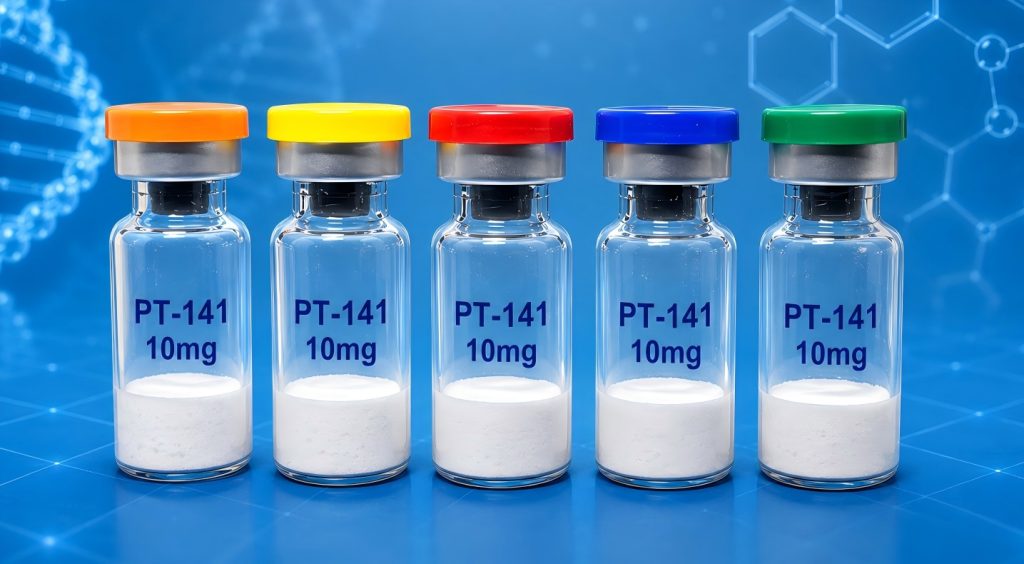
A vial label stating “PT-141 10 mg” is not, by itself, analytical proof of identity or content.
Nine Quality Questions Every PT-141 Buyer Should Ask
1. Is the complete cyclic-peptide structure defined?
The supplier should provide the complete sequence and explain how cyclization is achieved. The structure stated on the specification sheet should match the structure used to calculate the expected molecular mass.
2. Is the supplied form free base or acetate?
The quotation, label and COA should clearly identify the form. When acetate is present, the buyer should understand whether the reported vial content represents total material weight or peptide-equivalent content.
3. Is identity confirmed by mass spectrometry?
HPLC retention time alone is not sufficient molecular identification.
A batch-linked LC-MS or MALDI-TOF report should show an observed mass consistent with the stated structure and expected ion pattern.
4. Is the HPLC chromatogram available?
A purity percentage without the original chromatogram provides limited information.
Professional buyers may need to evaluate:
- Main-peak integration
- Related peaks
- Detection wavelength
- Column and mobile phase
- Gradient conditions
- Test date
- Batch number
- Acceptance criteria
5. Is purity being confused with net peptide content?
A result such as “99.8% by HPLC” normally describes chromatographic area purity under a defined method.
It does not automatically mean that 99.8% of the entire vial mass is active peptide. Water, acetate, residual solvents and other non-UV components can affect total material balance.
6. Are batch records traceable?
Long-term B2B purchasers should evaluate whether the supplier maintains:
- Raw-material traceability
- Production batch records
- Released and retained samples
- Deviation records
- Change-control procedures
- Complaint investigations
- Repeat-batch comparison data
- Document revision control
7. Are storage and transport conditions defined?
Cyclic peptides may still be affected by heat, moisture, oxidation and inappropriate handling.
The supplier should define sealed-material storage, light protection, packaging conditions and the procedure for assessing a temperature excursion.
8. Are research-grade and pharmaceutical-grade claims separated?
Research-grade material should not be marketed with wording that implies an approved sterile drug.
Terms such as “FDA approved,” “generic Vyleesi,” “safe injection” or “clinically interchangeable” should not be used for a research product unless the complete regulatory and pharmaceutical requirements have genuinely been met.
9. Can the supplier support repeat B2B procurement?
A professional source should be able to discuss:
- Qualification samples
- Multiple production batches
- Agreed specifications
- Bulk-order scheduling
- Custom labels and cartons
- Export documentation
- Batch reservation
- Long-term supply planning
- Technical-document review
HICORE LIFE PT-141 Research Peptide

HICORE LIFE supplies PT-141 research peptide to qualified laboratories, distributors and product-development organizations.
The current catalogue specification is:
- 10 mg per vial
- 10 vials per box
- Minimum order: 100 boxes or 1,000 vials
- Listed HPLC purity: ≥99.8%, subject to the released batch COA
Available batch-related documentation may include:
- Certificate of Analysis
- HPLC report and original chromatogram
- Mass-spectrometry report
- Safety Data Sheet
- Product specification
- Packaging and batch information
Final identity, acetate form, peptide content, purity and document availability must be confirmed during quotation and against the released batch records.
Manufacturer-Direct Peptide Supply
Backed by 15 years of peptide research, development and manufacturing experience, HICORE LIFE supports B2B customers requiring research peptides, analytical documentation, bulk quantities and customized packaging.
Our manufacturer-direct capabilities include:
- Research-peptide synthesis and production
- Bulk and repeat-order coordination
- Batch-specific quality documents
- Multiple packaging configurations
- Custom labels and private packaging
- Qualification-sample support
- OEM and ODM project review
- Export-document coordination
- Technical and commercial communication
Working directly with a manufacturing source can help professional buyers improve specification control, document communication and repeat-order consistency.
Manufacturing history, facility capabilities and quality-system claims should be supported during customer qualification by verifiable company records, equipment information, quality procedures and available audit documentation.
View the PT-141 Product Page
Qualified B2B customers can review the current catalogue specification and request a quotation through the official product page:
To receive a more accurate quotation, please provide:
- Required quantity
- Destination country
- Required peptide or acetate form
- Target HPLC purity
- Required identity or assay method
- Required COA, HPLC, MS or SDS documents
- Packaging and labeling requirements
- Qualification-sample requirements
- Expected purchasing schedule
Frequently Asked Questions
Is PT-141 the same molecule as bremelanotide?
PT-141 was the development designation used for bremelanotide. Commercial products should still be checked for the exact cyclic structure, salt form, assay and analytical identity.
Is every PT-141 product FDA approved?
No. FDA approval applies to the specific prescription drug Vyleesi and its approved formulation, manufacturing controls and indication. It does not automatically apply to third-party PT-141 research material.
Is PT-141 approved for men?
The FDA-approved Vyleesi indication does not include men. Early studies investigated bremelanotide in male subjects, but this does not create an approved male indication and does not establish third-party research-product equivalence.
Can HPLC purity confirm PT-141 identity?
No. HPLC purity and molecular identity are different quality attributes. Mass spectrometry or another validated identity method should also be reviewed.
Does 10 mg on a vial always mean 10 mg of net bremelanotide?
Not necessarily. Buyers should determine whether the stated content represents peptide equivalent, total lyophilized material or salt-form weight and should review the assay and calculation method.
What quality documents can buyers request?
Depending on the selected batch and grade, documentation may include a COA, HPLC chromatogram, MS report, SDS and product specification.
Is HICORE LIFE PT-141 intended for human use?
No. It is supplied exclusively for qualified laboratory research and analytical applications.
Conclusion
PT-141 has legitimate scientific importance in melanocortin receptor and cyclic-peptide research. It also has a commercial market in which clinical evidence, prescription-product information and unverified online materials are frequently mixed together.
A responsible B2B purchasing decision should not be based on promotional claims or individual testimonials.
It should be based on evidence that can be reviewed:
- Defined molecular structure
- Confirmed peptide identity
- Clearly stated acetate form
- Batch-specific HPLC data
- Appropriate peptide-content testing
- Traceable quality documentation
- Controlled storage and transportation
- Transparent research-use restrictions
HICORE LIFE supports qualified B2B customers with manufacturer-direct research-peptide supply, analytical documentation, bulk-order coordination and customized packaging.
For laboratory research use only. Not for human consumption, clinical use, diagnosis, treatment, drug compounding or veterinary use.